


Competition for capital is heating up. Persistent government deficits combined with a long overdue acceleration in corporate capex means bond markets face a wave of new supply. Is this a risk or opportunity?
Is this the right time for corporates to be spending?
Why not? Tariff clouds are clearing, most central banks have dialled back restrictive monetary policy, and in aggregate the world will benefit from additional fiscal stimulus in 2026. Rates markets face some well-flagged challenges – a bumpy disinflation journey and resilient but uneven growth (obscured by unreliable economic data). But for credit, this backdrop isn't all too concerning. Some stickiness in prices suggests that corporates have sufficient pricing power to pass rising costs (or tariff effects) on to consumers. Credit doesn't need blockbuster economic growth to perform well; it just needs to steer clear of recession.
A capex boom is overdue
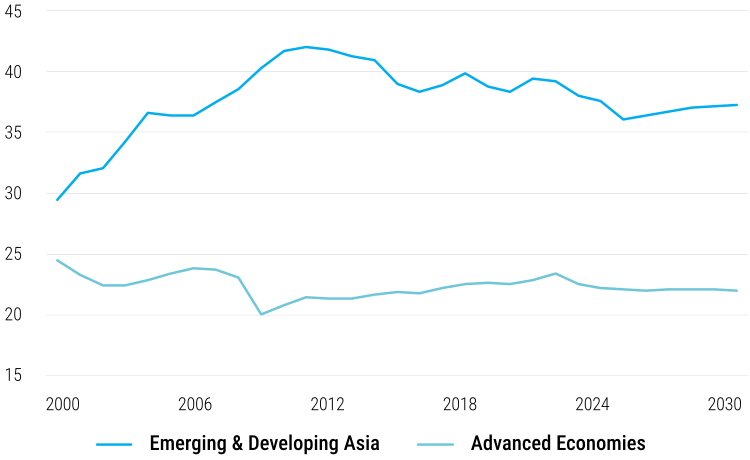
The past 30 years has seen a marked decline in fixed capital formation in developed economies, as production was generally outsourced to a booming Asian economy (accelerated by China's accession to the World Trade Organisation in 2001). The western corporate world saw great benefits from cheap Chinese manufactured goods, including the ability to keep domestic wages depressed. As Western jobs were exported to Asia, so too went investment in productive capacity, prompting a long trend of falling hours worked, stagnant productivity and low capital investment (Figure 1).
Figure 1: Investment as a share of GDP (%)
Source: Bloomberg, IMF, as of February 2026
This trend was compounded by the global financial crisis in 2008, which drove a decade of economic austerity and – more importantly – a concerted deleveraging of private sector balance sheets (Figure 2).
Figure 2: Debt-to-GDP growth in the US
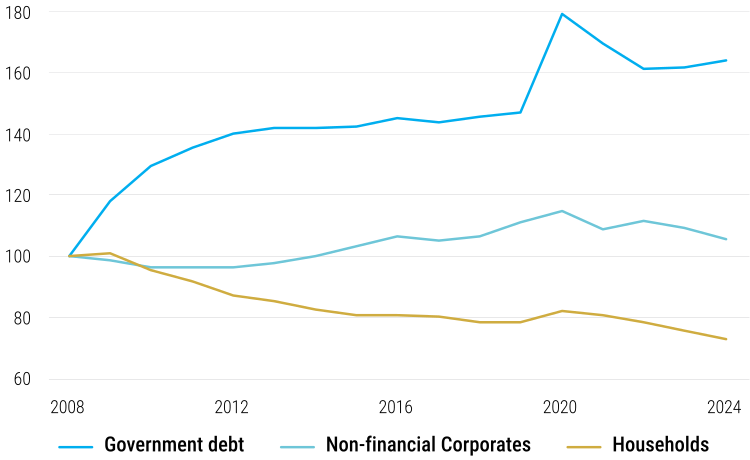
Source: Bloomberg, IMF, as of February 2026. Data indexed to 31 December 2008 = 100
Why is the capex trajectory changing? There is nothing quite like an inflation shock to drive social change. Lower income Western workers are demanding real wage gains now. Political priorities have also changed – the slow but deliberate path of deglobalisation, which started back in the first Trump administration, has empowered greater labour market collectivism.
Politicians are tuned into the changing tide. Note, for example, the jump in tax relief on business investment across several developed economies. In the US particularly, the One Big Beautiful Bill Act (OBBBA) allows for 100% expensing of capital expenditure (capex) depreciation in the year of purchases, and the ability to add depreciation/amortisation for the purposes of interest expense deduction. Combined, these measures reduce the aftertax cost of debt-fuelled capex for corporates.
Author

Important information:
For use by professional clients and/or equivalent investor types in your jurisdiction (not to be used with or passed on to retail clients). For marketing purposes.
This document is intended for informational purposes only and should not be considered representative of any particular investment. This should not be considered an offer or solicitation to buy or sell any securities or other financial instruments, or to provide investment advice or services. Investing involves risk including the risk of loss of principal. Your capital is at risk. Market risk may affect a single issuer, sector of the economy, industry or the market as a whole. The value of investments is not guaranteed, and therefore an investor may not get back the amount invested. International investing involves certain risks and volatility due to potential political, economic or currency fluctuations and different financial and accounting standards. The securities included herein are for illustrative purposes only, subject to change and should not be construed as a recommendation to buy or sell. Securities discussed may or may not prove profitable. The views expressed are as of the date given, may change as market or other conditions change and may differ from views expressed by other Columbia Threadneedle Investments (Columbia Threadneedle) associates or affiliates. Actual investments or investment decisions made by Columbia Threadneedle and its affiliates, whether for its own account or on behalf of clients, may not necessarily reflect the views expressed. This information is not intended to provide investment advice and does not take into consideration individual investor circumstances. Investment decisions should always be made based on an investor's specific financial needs, objectives, goals, time horizon and risk tolerance. Asset classes described may not be suitable for all investors. Past performance does not guarantee future results, and no forecast should be considered a guarantee either. Information and opinions provided by third parties have been obtained from sources believed to be reliable, but accuracy and completeness cannot be guaranteed. This document and its contents have not been reviewed by any regulatory authority.
Issued by Threadneedle Asset Management Limited, No. 573204 and/or Columbia Threadneedle Management Limited, No. 517895, both registered in England and Wales and authorised and regulated in the UK by the Financial Conduct Authority.
Columbia Threadneedle Investments is the global brand name of the Columbia and Threadneedle group of companies. © 2026 Columbia Threadneedle. All rights reserved.


